Sunday, July 31, 2016

European Flashbacks

Weeks after our return from Europe, images and newly-acquired information continue to surface in my memory: the breathtaking beauty of the St. Petersburg Church of the Spilled Blood, Adriaen Van De Velde’s detailed depictions of Dutch landscapes and medieval daily life, stories of tsarinas and kings, conspirators and war heroes, battles and treaties.
Musical moments also come back to me, although the sounds of music are more difficult to recall than visual imagery. What I do remember is how the music made me feel, the euphoria it produced. The magnificent organs in every church spoke of the importance of religious music in centuries past. We visited a cathedral just at the right moment to hear the powerful swells of music from the organ that filled an entire wall.

Outside El Prado Museum in Madrid, a man sat on a wall playing on his guitar the Concierto de Aranjuez, perfect for creating the mood to view the paintings of Velázquez, El Greco and Goya.
  Amsterdam’s Concertgebouw, its dimmed chandeliers glittering like fairy candles, provided a magical venue for opera music from Wagner, Massenet, Bizet and Saint-Saens. There the sweet notes of a violin solo rang clear and perfect, glorious and true in that hall famous for its acoustics. When friends ask me what the best of our trip was, I tell them about that evening concert.


Tuesday, July 26, 2016

Sneak Preview

A warm sunny day in midwinter is delicious. Outside tiny wild canaries twitter in the branches above me. I tell them that I feel like singing, too. I walk with an energized pace along the sidewalk, but then stop and sniff the air. Is that scent what I think it is? Yes, there in a garden – the yellow buds of an acacia are opening, perfuming the air with the fragrance that triggers childhood memories of early signs of spring in California. Acacia and daphnia scents always remind my gardener’s nose of the promise of spring days.
            The memory of brightly colored flowers in the Baltic countries even in the smallest spaces – doorways and windowsills – prompts me to put in some winter blooming plants in pots to shed some light on grey winter days. Just back home, I buy primroses – red, yellow, purple – and primulas. Trowel in hand, I work them into the soil in three large pots. Like the nesting instinct of birds, my gardener impulses are activated by the sun. Maybe having recently come from northern summer climes has them bewildered.

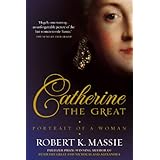
            This spring preview can’t last. Rain is predicted in a few days. But I have the view of my bright flowers. To the patter of rain, I’ll bite into a chocolate bar and return to the biography of Catherine the Great, a story of courage, perseverance and intrigue. With ingenuity she fools her tutors, chaperones and the Tsarina Elizabeth who keep her a virtual prisoner in the palace. She dresses as a boy to escape at night to meet her lover. She pulls a curtain over an alcove in her apartment to hide the friends gathered there.
Now I read of her efforts as Tsarina to determine the shape of Russian society and government and reorganize the legal system. A daughter of the Enlightenment, she aims to abolish capital punishment and the use of torture and guarantee equal treatment for all citizens, even the serfs. She publishes her document, the Nakaz, in 1767.
                                                Product Details
How is it possible that these issues continue to be debated centuries later? Today’s leaders and governments would definitely benefit from a large dose of enlightenment.

Monday, July 18, 2016

My Russian Mosaic

A metronome ticks and stops. Music plays. The metronome ticks and stops. Music plays. The transmission of Leningrad Radio keeping alive the hopes of the city’s inhabitants. It is 1944. The German army siege continues to its strangle-hold over the city during the past 900 days. One million people are dead due to cold and starvation.


            I stand in the windowless museum commemorating the heroic defenders of Leningrad (now St. Petersburg). That recreation of the radio’s transmission takes me back in time, more real than the battered army helmets, rifles and photos on display.
            Valentín, our 40-year-old guide, tells how the siege affected his family. His grandmother died of starvation. His grandfather’s brother disappeared. The rest of the family was eventually evacuated through the one route open to the interior. In impeccable Spanish he tells us, “No one is alive today who hasn’t lost someone in the siege.”

Back in Chile, I look over the past three weeks of travel in Europe trying to process all that my senses have taken in. Certain moments and places stand out, like the siege museum in St. Petersburg. Already my memories grow fuzzy. I write to Valentín. What is the music in the radio transmissions? He sends me a recording of the transmission and the popular Russian song on which the music is based. I listen. It strikes me that the ticking of a metronome and the strains of a song can affect me so strongly. Once again I am back to those tragic times. These are no longer just historical facts but real events within my generation’s lifetime.
Valentín takes us to a metro station constructed during the years of Communist rule. We descend into a work of art of marble columns, mosaics, gold carvings of Soviet designs and of workers of different trades, their faces reflecting pride and strength. Beautifully wrought chandeliers light up the spacious hall. We board a train that rattles and rumbles us to the next station. We stand awe-struck at the elegance.


These impressions are mosaic pieces that I must fit together in my mind, constructing a picture of the Russian people, their history, their culture. I have begun to read a biography of Catherine the Great. More pieces to fit into my mural.

Wednesday, June 15, 2016

Glimmers

It’s not difficult to feel grumpy, irritated and downright depressed in this city of ours, what with grey winter days, carjacking, house and mall robberies, traffic gridlocks and hooded vandals destroying and looting during weekly student demonstrations. These scenes have become our daily bread. Days ago a water main broke on a principal artery of the city. A deluge of escaping water flowed down towards the center of town. Surface traffic and a major metro line were cut. The news showed streams of city folk walking long distances to work.
But, all is not gloom. I laughed out loud at the sight of a young, well-dressed woman, desperate to cross the street, clambering aboard a grocery cart pushed by an ingenious Chileno. For a few pesos he delivered her across the river to the opposite corner. Oh, those enterprising Chileans. At the first drop of rain, they’re selling umbrellas at metro stations, or cellophane wrapped roses for Mother’s Day, or ready-made salads and sandwiches at lunchtime.
I see glimmers of hope and humor as I go about my city.  One night a friend and I decided to go to a concert of the Santiago Symphonic Orchestra downtown, which meant boarding the metro at peak commuter hour. We are not the pushy type but, when it came to a packed metro car, we had no choice but to squeeze and elbow our way in, that is, if we wanted to go anywhere.
The live performance of Tchaikowsky’s glorious Fourth Symphony swept me away on a wave of wonder to the steppes of Russia and the glittering halls of the Hermitage. Unbelievable, the magic created by those violins, violas, cellos and bass.
Returning home on the metro, passengers eyed us as we broke into giggles, lifting our feet to avoid contact with two large balls of hair rolling down the aisle and back again, not an unusual sight in the otherwise clean metro cars.
A sharp clear blue sky greeted me this morning and, in the distance, the snow-covered ridges gleamed. A gaggle (at least a dozen) of rowdy green parrots invaded the liquidambar tree next door, gorging on the seeds of the prickly pods. On the ground turtle doves grazed on the fallen leftovers.

Like the seeds of the liquidambar, abundant reasons for joy and laughter are here for the taking in this urban landscape. It’s a matter of paying attention.

Sunday, June 5, 2016

Liquid Contentment


 My redwood tree looks perky and content. The neighborhood robins are out breakfasting on an abundance of juicy worms. Hummingbirds squeal and careen in delight. Wet leaves cover the pavement. Even I feel light and energized after the refreshing rain yesterday. After years of drought, rain is reason for celebration. I also am grateful for the clear skies after days of smothering smog, and for the white ring of snow on the Andes surrounding the city.
            Our current rainfall is three times greater than last year at this time, and winter doesn’t start for three more weeks. I wonder what the rain gods have in store for the next few months.
The rainfall in the usually wet southern Chile has diminished. The city of Coyhaique, set in a bowl of verdant hills, is rated as one of the most contaminated cities in the world. Besides the scarcity of rainfall, its problem lies in a longtime tradition in the damp, cold south – wood burning stoves. They are the heart of all southern homes, providing warmth, heat for baking bread and heating water and a gathering place for the family and friends. Because of the increasing pollution as the city grows, authorities are mandating a change to gas stoves. A loss for the inhabitants of the city, but wood stoves will continue to burn in countryside and small town kitchens.

            Days later we are blessed with two more days of solid rain. This morning the sun makes an appearance in a true blue sky with patches of luminous puffy clouds. A great morning for a walk. Many others have the same idea. The sun draws us out of our dens: runners, some with dogs, cyclists, flocks of showy, squawking parrots, wild canaries and house wrens. The yellow leaves on the ground glow in the sunlight. The air is brisk and hopeful. And the mountains…they have revealed to us their gift of white splendor.

Thursday, May 26, 2016

Meet My Cousin Bob Mushroom


 Since I lean increasingly towards nature writing, I find myself ordering Kindle books on the topic. I’m delighted with my latest purchase: The Tree: A Natural History of What Trees Are, How They Live, and Why They Matter by Colin Trudge. In very accessible prose, he provides a truly refreshing “refresher” course in basic biology.
Product Details
 In high school, as I was on the college track, I was instructed to take chemistry and physics, rather than biology. Maybe biology was considered a lesser science then. In college Biology 1A and B, I barely scraped by. I was a liberal arts gal.
 Fast forward fifty years: Now I realize that I want to deepen my understanding of the scientific foundations of the natural world – the evolution of scientific names for things and Carolus Linaeus’ system of classification: species, genus, orders, classes and kingdoms (later phylum was inserted between class and kingdom and domain added after kingdom). Add to that the later use of phylogeny, the family tree of the natural world demonstrating the relationship between the different groups of creatures. I’m learning (or maybe relearning?) biological concepts like analogous and homologous, convergence and divergence, and most confusing to me, haploid, diploid, polyploid and tetraploid (which has to do with genetics, hybrids, chromosomes and all that stuff that gave me so much trouble in college biology). Fortunately, I don’t have to take a test on this material, but just grasping the broad concepts is enhancing my wonder for the complexities, order and vastness of nature.
I totally share Mr. Trudge’s love for the idea that we humans are literally related to all things. He plays with the notions that ‘apes are our sisters, and mushrooms our cousins, and oak trees and monkey puzzle are our distant uncles and aunts.’ (Uh - I’d like you to meet my cousin Bob Mushroom.) Like when involved in a good novel, I can’t wait to get back to Mr. Trudge and his trees. On to chapter three: How Trees Became.
Today, as I walked down the street, I looked at the city trees with new eyes and wondered what they were saying to each other. If only I knew their language.

Baobob Tree  Adansonia grandidieri


Monday, May 9, 2016

Acceptance

Acceptance


In my memoir “Marrying Santiago” (2015) I wonder where my two sons would choose to put down roots. I ask: “Would I lose them someday to the place I left behind?” My parents’ only child, I left my California home forty-five years ago to marry and live in Chile. The great distance that separated us was the source of tremendous sorrow for them.  
            While my oldest son married and settled in Chile, the younger one has been living and working in New York for four years. I miss him terribly. Living in this hyper-connected era does ease the pain somewhat – we chat online, talk by Whatsapp and Skype and send photos taken instants before.
 Today a Chilean friend who passed through New York brings me a present from my son. An enchanting little book entitled “Owls: Our Most Charming Bird” by Matt Sewell. A rich text accompanies the delightful drawings. I am so pleased with this gift that I immediately call my son. We don’t talk long as he is at work, but just hearing his voice brings me pleasure. I recently ordered Bill Bryson’s “A Walk in the Woods” for him. Since he’s a hiker, I thought he’d like it. He did.


With these small exchanges – books, photos, and online chats – the distance seems less. Last month he sent me a photo to show he’d just voted in the New York primary. I’m happy he takes seriously his American citizenship. I recently voted in the California primary by absentee ballot – signed, sealed and delivered (well, actually faxed). My son and I agree on the presidential candidate.


 This not just the expatriate’s or the immigrant’s dilemma. Several of my California high school and university classmates have children living on the east coast (many in Brooklyn, like my son.) But Brooklyn is a lot further from Chile than California. Here I’m at the bottom of the world.

Will he return to Chile someday? That is a question that must wait for an answer, and I must accept whatever choices he makes.