Friday, November 27, 2015

Mangrove Marshes, Mosquitoes and a Motorcycle


The next-to-last day of my Barranquilla sojourn.  I’ve arranged to meet early this morning with Omar, a guide at the Isla de Salamanca National Park to go bird watching.
“How do I get there?” I ask him on the phone in Spanish.
“Take the bus from the terminal to Santa Marta, but ask the driver to let you off at Los Cocos, or the Park, just four kilometers past the toll booth.”
Milling passengers swarm through the bus terminal. I find a ticket office for buses to Santa Marta. Bus 3039 is about to leave. A friendly young man helps me locate it in the line of buses outside.
I sit in a seat right behind the driver to make sure he understands where I want to get off. As if I knew.
Forty minutes later, the bus slows and the driver’s assistant nods to me. I step out onto the edge of the two-lane highway, shimmering with heat waves and bordered with a wall of green vegetation, palm trees poking up their spiky, disheveled fronds in the distance. I look about seeing nothing but a Park sign.
“Susana!” A voice calls and off of a side road steps a dark-haired young man, skin the shade of café con leche, a camera hung around his neck. I presume this is Omar. We shake hands, and I follow him into the park. Ahead on the terrace of a small building a group of young people sit around tables.
“English classes,” Omar says. “They are tourism students.” He introduces me to the teacher who announces to the class that they have before them a native English speaker. They twitter and stare.
“Would you please talk to them about the importance of learning English?” asks the teacher.
I’ve come to bird watch and now must say something inspiring to these eager students. I manage to say how English facilitates travel in almost every country as well as increases employment opportunities. The teacher seems satisfied. They all clap.
Omar hands me binoculars, and I follow him into the park. He has an acute ear for bird calls and excitedly points out among the branches our first feathered sighting. He announces that it’s a parkesia noveboracensis..
“Omar, por favor, what’s the common name for it?”
I expected he’d provide me with the local name. Instead, he opens his English language field guide to Colombian birds, points to the image of the northern water thrush and attempts pronouncing it in English. I correct his pronunciation, but his tongue stumbles over the thr of thrush.
“You must put your tongue between your teeth, like this.” I demonstrate, exaggerating the sound. “TTHHHRRRR.” He tells me he’s very anxious to learn English and continues struggling to pronounce the birds’ names in English.


The park is unexpectedly dry below the tree canopy. It hasn’t rained much, Omar tells me. All the trees in the park are mangroves. Omar points out three different types. I snap photos of their grabbing snake-like roots. It becomes clear that this is also mosquito land. At least, I remembered to bring insect repellant. We both swat our way through the groves and past the ciénagas, wide marshes, ringed by more green vegetation. He points to a path formed at night by the caimánes, the crocodiles. The deeper into the park we go and as my eyes grow accustomed to the light and the colors, the more birds we spot. The sighting of an unbelievably-camouflaged nighthawk is a highpoint.
When we finish the circuit of trails, I ask Omar to help me make a list of what we have seen, seventeen species in all, including sandpipers, parakeets, woodcreepers, flycatchers, woodpeckers and the spectacular russet-throated puffbird.
I thank Omar, pay him and ask: “How do I get back to Barranquilla now?”
“We sit by the highway and flag down the bus.”
We sit on the curb in a spot of shade and wait. Trucks, cars and fancy buses speed by, but not the local bus that would stop here, in the middle of nowhere, to take on a passenger. The blazing midday sun is well overhead when Omar says maybe I’ll have to catch the bus at the town of Palomar.
“And how do I get there?” I ask, tired and sweaty, trying not to scratch the growing red welts on my legs.
“I’ll flag down my friend who has a moto-taxi. He’s very trustworthy.”
At this point, I’d accept a ride on a burro.
Soon his friend putts up. Omar explains the situation and the driver agrees. He hands me a grimy helmet and holds out his hand to help me onto the back of his motorcycle.
“Where do I put my hands?”
“Around my waist,” the young man answers, and off we roar.
The rush of air is soothing and I try to relax and enjoy the view. Oh, if my husband could see me now. Omar’s friend is careful with his white-haired, pale-faced passenger, sticking to the edge of the road. I wonder how fast we’re going and look down at the speedometer. Zero kilometers per hour? The gas gauge needle points at E. Empty. What if we run out of gas? Then it dawns on me that this moto-taxi is a patchwork hybrid, likely put together ‘one piece at a time’ like Johnny Cash’s Cadillac. After fifteen or twenty minutes, I wonder how far this town of Palomar is. Maybe Omar’s friend isn’t as trustworthy as he claimed. Is he planning to take me hostage? When we pass the toll booth, I know we’re nearing the wide Magdalena River. This is much further than I thought. What a relief when my driver slows and stops by a clutch of roadside stands. In less than a minute a bus sporting tropical colors emerges from a side road.
“There it is. Once in town you must get off at Calle 17 and take a taxi from there,” he announces and waves to the driver to stop.
I climb aboard. A woman with a child gestures me to sit next to her in the front row. I’m tickled. This is the kind of bus I used to ride here fifty years ago. A green fringe edges the windshield and stuffed toy animals – a bear, a dog, a rabbit, an elephant – dangle and sway from the roof over the driver’s area. His seat is upholstered in a plastic blue, fringed material. We sway in our seats to the rhythm of coastal music – meringue, cumbia - blaring from loud speakers behind the driver. Warm air blows through the open door.
 This is what I’d come for.


                                                                          October, 2015, Barranquilla

Tuesday, November 17, 2015

Red Zone

            The multiple warnings will not stop me.
A volunteer in the Barranquilla Peace Corps office reminds me, “The barrio where you worked is a red zone now for Peace Corps. We’re not allowed there for security reasons.” I figure that I’m no longer under the jurisdiction of Peace Corps.
I query several taxi drivers about Las Americas. Is it dangerous? They all agree that it is, but I find this difficult to believe or maybe I just don’t want to believe it.
Besides, I’m working on a contact there. Weeks ago I wrote to the Office of Citizen Participation in the Barranquilla City Hall, explained my story and requested help in contacting the president of the barrio’s Junta of Community Action. I received no response. I worried that my search would lead me to a dead end.
The morning after my arrival I head to the sixth floor of the bustling City Hall. Expecting difficulties after all the years that have passed, I’m anxious to begin. I have only a week. At the front desk I am directed to a man nearby. “Jorge Romero is the one to talk to.”
Yes, he had received my email.
“You didn’t answer me.”
“Elections are this Sunday and it’s been a very busy time.”
“Can you help me? I want to contact the president of the Junta in barrio Las Americas. I want to go there and need someone from there to accompany me. People tell me it’s dangerous.”
He checks his computer and writes down the name of the president, address and cell phone number. Telephones in Las Américas! I’m thrilled.
Sr. Romero picks up his phone. I realize he’s calling Alfonso, the president. He explains who I am and that I will be contacting him.
“How do I get there?” I ask. “I checked out the barrio on Google Earth. It’s so changed now. I’d get lost.”
He prints out a Google map and traces a line on it for the taxi to follow. I could have kissed him.
That evening I call Alfonso, and we make plans to meet at his house the day after next. I’d promised my husband I wouldn’t go there alone, so I’ve asked Flaco Bob to accompany me.
Bob and I flag down one of the ubiquitous yellow Chevrolet Spark taxis that swarm through the city like indomitable bees. I ask the driver if he’s willing to go there. “I have this map” I say, handing it to him.
We take a wide, busy street lined with small businesses and stores and, after half an hour, turn left onto the street marked on my map. The driver says, “This is Las Americas.”
I gaze out the taxi window in shock and disappointment. In the rows of solid simple houses nothing is familiar. No remembered landmarks. Where is the barrio of my memories? We soon pull up to Alfonso’s house, its façade papered with a huge ad promoting him for city “edil” in Sunday’s elections. (I had to look that one up. Edile: a magistrate in ancient Rome in charge of public works, buildings and roads.) A young man appears in the open doorway, wearing a tee-shirt proclaiming Junta de Acción Comunal Las Americas. We shake hands and he invites Bob and me inside. The bare cement walls and floor look freshly constructed. Was this until recently a wooden shack?
“Las Américas is so changed,” I tell Alfonso. “Nothing looks familiar.” I pull an envelope out of my purse. “I noticed on the city webpage you’ve written a short history of the barrio. I’ve brought copies of some old photos for you, so you can see what the barrio was like then.” I hand him a photo. “Here are the men working on the health center. This one shows the inauguration.”
He studies the photos with great interest. “We have a new health center now,” he says. “We’ll have to go there.”
“And the original health center we built?” I’m anxious to see it. So much sacrifice and sweat went into its construction. My parents held a fund raiser to pay for the roof.
“The city is going to rebuild it and convert it into a senior center.”
We step outside into the shade of a tree. I look around. Instead of wooden shacks perched precariously on rolling hills of eroded, barren red soil, I see trees, vegetation and cinder-block houses. A few shacks remain like the one next door to Alfonso where he tells me three families live. I tell Bob, “That’s what all the houses were like when I worked here.”
Women wander up and join us, including Alfonso’s sister and his mother, a small, smiling woman wearing a white tee-shirt with the image of a pious-looking saint and the saint’s name, Santa María Goretti. 

Alfonso introduces us explaining that I’m the one who helped build the old health center. More gather. I immediately forget the names given. Not one is familiar. Alfonso passes the photos around.
 “Look, there’s my father in that photo!” says a neighbor.
We start off down a paved street, Alfonso and his sister like emissaries escorting visiting dignitaries. On a corner under a tree a group of young men in blue jeans and tee-shirts hang out with their motorcycles. I’m wary. The term “red zone” pops up in my mind like a warning flag. But Alfonso walks right up to the group and introduces me. “These men all drive moto-taxis,” he explains. He shows them the photos I’ve brought. They pass them around, pointing out people they recognize.
“That’s what Las Americas looked like fifty years ago,” I tell them.
We laugh, and they crowd around for photos, me perched on a motorcycle seat. I even consider the possibility of arranging a ride back to the hotel later with one of them, until I recall the recklessness of those motorcyclists in crowded downtown.
Alfonso moves our little party along. “Let’s go down this street where Señora Nidia lives.”
Older women in faded shorts and skirts, tee-shirts and flip-flops drift out of neighboring houses. Again names flit by, air-borne words I cannot grasp. Most remember me, and I feel badly that I don’t remember them. I want to remember them.  But I worked mainly with men when I was here, all of whom are now dead.
“Oh yes, my mother used to talk about Señorita Susana.”
“My grandmother spoke of you.”
 “You knew my mother. I’m the daughter of Modesta Borerro.”
“Of course, Señora Modesta,” I say. “She was always dressed in black and had a severely malnourished grandchild, Doris. Didn’t she die?”
“No! Doris is married and has children.”
We gather in a semi-circle for multiple photos, our arms linked.
A woman crosses the street towards us. “Here’s Nancy Vasquez,” someone says.
“Nancy!” We hug and laugh. She had been a teenager in a women’s group we organized back then. I show her a photo where she appears.


Alfonso urges us on. “I’d like to see the old health center,” I tell him. “My friends Fidelia and Petra lived on the same street.” We ask at various doorways (always open to welcome the slightest breeze), but the news is not good. Both had passed away. I’m also terribly saddened to see that the health center is boarded up, the construction now considered unsafe, but I take comfort in knowing that it served this community for several decades.
The large modern health center looks out of place, as if some city official plunked it down here by mistake.  How is it possible? This in Las Américas? In the spacious, immaculate, air-conditioned interior, Alfonso introduces me to the doctor and a nurse. I’m pleased when the doctor tells me that he used to work in the old health center, indicating to me his dedication to this community, one that many doctors might avoid. Several patients are waiting their turn. One smiles and waves. “I remember you!”
We visit a ‘mega-school’, one of two that receive children from pre-kinder age through high school. Neatly-uniformed boys and girls chatter and scurry through the hallways. A tussle erupts between two young boys. “He hit me with his backpack.” Hallway bulletin boards carry messages about democratic values and beneficial environmental practices. Our tour includes the gym which serves as a cafeteria where the students receive lunch. Alfonso introduces me to the school director, a small, middle-aged man with a very long grey beard. He explains that a Canadian Baptist organization founded and runs the school.
“Are these children all from Las Américas?” I ask.
He reassures me they are. We pose for photos with other administrators and two small children. I photograph the littlest ones napping on mats. As we leave, I congratulate the director on the magnificent work they do. I am in a state of disbelief. Is this really the same barrio that fifty years ago had just one two-room school?
Bob comments that my face is very red. Beads of perspiration slide down my neck, my arms, under my bra, but I can’t say no when Alfonso says I must see the church, which I remembered, and meet the priest. Adjacent to the church is the Escuela Golda Meir, founded by the Barranquilla Jewish women’s community. Different faiths in harmony side by side.
I’m elated to see the many improvements in infrastructure and services in my old barrio: running water, schools, health centers, football fields and some paved streets. But, talking to the neighbors, I realize that most of these improvements only occurred in the past decade, under the administrations of the past two mayors, one of whom will undoubtedly be re-elected on Sunday. Yet, I knew it took much longer for each determined, hard-working family to convert its fragile wooden shack into a solid house, cement block by cement block.
 Alfonso is busy with elections just four days off, so I suggest we find a taxi.
     “But I don’t want to leave until I’ve seen Agripina.” She was another 13 year-old in our women’s group. Alfonso guides the taxi driver up a rocky incline to a small, rundown house. He announces my arrival to Agripina. I pass through the front door of peeling brown paint into a small drab living room, equipped with a few basic pieces of furniture. I would never have recognized her without the introduction. How can this gaunt, bent and flat-chested woman be the same person as the perky, smiling girl with hopeful eyes in the photo I carry? We embrace and then smile for the camera against the backdrop of a cracked, patched wall and a crude, lopsided painting. I show her the black and white snapshot I brought. It is my only copy but it is all I have to give to her. We hug farewell. I cannot linger; the taxi awaits us outside.
I feel overwhelmed as if a whirlwind has whisked me through the barrio, a dream run in fast-forward.  So many more questions to ask. I thought maybe someone might have invited me back another day for a more leisurely visit. I would have suggested it if I’d had more time to chat. I had wanted to visit Eugenia the former president’s wife, now a widow. In spite of the deplorable conditions in which I saw her decades ago, she outlived her husband.
We drop off Alfonso and his sister at a corner. I thank him and wish him suerte in the upcoming elections. Although I’m on the verge of sunstroke, I lament that this will be my only visit to this place that marked me with such an outpouring of love – then and now.
 Just three short hours after fifty long years.


                                           October, 2015, Barranquilla

Saturday, October 31, 2015


Journey to the Unknown


On board Avianca flight #98, I’m headed to Bogotá and then Barranquilla. The map on the screen on the seat back in front of me indicates we are over the desert of northern Chile – in spectacular bloom now after an unusual rainy winter.
I’m in a state of disbelief. Returning to Barranquilla after 48 years. When I was 23 or 24. I feel I’m returning to my past. Diaphanous clouds of memories drift in my head, of other flights, landscapes and faces of people I knew then: barrio friends, boyfriends.
It will all be changed now. Google maps and Streets reveal my old barrio, once a shanty town- invasion barrio, now looks more solid. Some streets are paved! Will they have running water now? Indoor toilets? Will I locate my friends Petra, Fidelia, Dominga’s daughter or my godson Jose?
And I have changed, now a white-haired grandmother. Will they recognize me? This is a journey to many unknowns. The people and places that populate my nostalgia no longer exist as I remember them. Will I be disappointed? My shadowy memories must confront reality or make peace with it. I’m reluctant to give up those visual scenes in my head from five decades ago. The airplane magazine reveals a modern Colombia of malls and pricey condos, like my home, Santiago. The scenes sadden me, but the past and the present must meet – a gap I must bridge.
I am not the same person now, not just physically. In my memories I’m 22, 23, naïve but idealistic. Young, single, and ruled by raging hormones in that sultry, suffocating, relentless climate. I went there to give of myself. What can I give now?
We land in grey, cloudy Bogotá. I feel tears welling up. I’m on Colombian ground once more. I wend my way through the enormous airport to find my connection to Barranquilla. The flight is just over an hour. The landscape I view from my window tells me we’re getting close: the wide, meandering Magdalena River, broad expanses of flat marshy countryside.
A mass of hot air envelops me as I emerge from the Barranquilla airport, the searing, humid climate I remember so vividly. I look around for Bob who said he’d try to meet me there. Soon I’m the only passenger left so I board a small yellow taxi which careens, honking, through heavy traffic on unfamiliar streets. “What barrio is this?” I ask the driver, but the name means nothing. I feel a complete stranger visiting the city for the first time, a city I once knew so well. Only the iconic El Prado Hotel, sixty-five years old, as elegant as I recall, is familiar. In the lobby, some gringos look at me and ask, “Peace Corps?” With relief, I learn they are staff, and they offer to take me to the Peace Corps office to meet others who gathered for the event commemorating twenty-five years of Peace Corps in Colombia. Volunteers returned to Colombia just five years ago after a long absence for security reasons. 
I no longer feel lost and alone.

Friday, October 9, 2015

Required Reading

I recently read David McCullough’s biography of John Adams. Having lived outside of the United States for over four decades, my knowledge of U.S. history had become embarrassingly rusty. I’ve wanted for some time to remedy that situation.
            The book read like a novel, grabbing my interest from the first page. I was fascinated. John Adams became for me a real person, lovable with his strengths, weaknesses and foibles. His insistence on living a simple life and his love of rural America held special appeal for me. His stubborn belief in his opinions and grasp of critical political situations proved in the long run the wisdom of many important decisions. As third president of the United States, knowing the horrors of war, for years he held out for peace, finally achieving it, with belligerent French and English governments amidst the calls of war by his detractors.
            When many colonists were in doubt, he had clear the need for independence, writing pamphlets and newspaper articles to convince others. It’s amazing to think of the task that our forefathers faced: to create a unified government where none had ever existed before. What should the government of those newly-created United States look like? What should the Constitution look like? Adams insisted on a three-branch government, containing a system of checks and balances. He believed in strong executive powers, while his opponents fought for more powers in the individual States. This later group called themselves “Republicans” as opposed to the “Federalists.” Sound familiar?

The parallels with today’s U.S. politics almost leaped off the page. The same forces and belief systems vie for power today. Is history repeating itself? Have we learned nothing in over two hundred years? We Americans need the perspective of the past in order to understand the present.  If I were in position of power, I would make David McCulllough’s John Adams required reading in every civics class across the country.

Wednesday, September 30, 2015

The Call of the Tropics

I’ve done it. Reserved a flight for Barranquilla, Colombia in three weeks time. It’s been a long-time wish of mine to return to the barrios in Barranquilla where I served as a Peace Corps Volunteer. Fifty years have passed, yet the imprint left by those experiences and those people continues strong. A formal invitation in Spanish arrived by email announcing a ceremony commemorating a total of twenty-five years of Peace Corps service in Colombia. Not twenty-five consecutive years as for many years as it was considered unsafe to send volunteers there.
I’ve been filled with apprehension while taking this decision. Browsing Internet I learn the new reality of the city and the barrios of Las Américas and Santuario. They have changed drastically. Some roads are now paved and wooden shacks transformed into solidly-built, though still humble, homes. These began as invasion barrios, shanty towns with no plan or organization. I once knew my way in the dark through the labyrinth of dirt roads. Now I would lose my way.
My doubts peak with an email from the Barranquilla Peace Corps office responding to my inquiries. Las Américas is now considered a “red zone”, off limits for Peace Corps for security reasons. I read online news items of criminals, murders and gang fights. On the other hand, there is news of large new schools, a new health center (the first one was my last project while working there), football programs for kids.
I will persist. I want to be adventuresome. Flaco Bob, from my old training group, emails that he is going and offers to accompany me in my searches. He knows the city well and has contacts. I dig out old letters and jot down names and the address of a godson, whom I last heard from in 1996. Will I be able to locate my dear friends Petra and Fidelia in Las Américas? I have no addresses for them. No one used street names or house numbers in those years.
    I’m gathering photos, letters and yellowed newspaper clippings to take. I am hopeful. I want to hear once more the wild, wonderful cacophony of the frogs in the night.


Monday, September 21, 2015

Chile’s True Colors

Three days of music, dancing, barbecues and shows, while red, white and blue flags brightened city streets, honoring September 18th, Chile’s Independence Day. Lines of cars and buses filled the roads out of the city – to the coast, to the countryside. Like many others, though, we stayed in town. Hubby needed some down time after his long flight home from Italy. Some stayed in town to settle their nerves.
Two days before the celebrations began, this land performed true to its geography. I was sitting home alone at my computer (hubby was en route in the sky somewhere) when the shaking began. A strong sideways movement (8.4 at its epicenter) that seemed endless.  I held onto my desk and waited it out. An hour later, another one. I went to get a flashlight, just in case. Fortunately, no damage, just pictures rocked askew on the walls. Immediately, a text message from my Brooklyn-er son. I assured him all was well. The next day a flood of emails from concerned friends in the States.
On the second day of the festivities, I suggested to hubby that we go with friends to the “fonda”, a traditional Independence week fair. Everyone who hadn’t gone out of town was there. Families with children and their dogs dressed in traditional costumes.


 We bought lunch at food trucks, while, mouth-watering smells of roasting pig and lamb tempted crowds to wait in long lines.
Enough for all


 Exhibits and traditional dancing and games attracted others. We headed to a large field ringed by bleachers to watch a demonstration of the Army’s Hussars Death Squadron, attired in pre-independence uniforms, bearing spears and mounted on handsome black horses. Their skills and precision drew enthusiastic applause. Once again I lamented that I’d never had the opportunity to learn to ride those magnificent creatures.
Selling beef jerky and "cuchuflí" Chilean sweets


Stiff and sore from the long stretch on hard bleachers, we headed for the exit gate, as new arrivals poured in. We’d immersed ourselves in Chilean traditions and were ready for the comforts of home, the start of spring in two days – and a series of ongoing aftershocks.

Wednesday, September 16, 2015

Detour to the Unexpected

A strange sight greeted us as we stepped out of the downtown metro station – no traffic on the Alameda, the city’s main artery, no roaring cars, buses, trucks, taxis and motorcycles. Nothing. Nada. At the end of the block, in front of the Moneda, the presidential palace, a series of barricades were detouring cars.
 I’d come with two sisters-in-law to attend a free noonday Sunday concert downtown. At the theater, we found all the doors closed, people wandering about with puzzled faces. We learned that the concert was cancelled because this was the route of a protest march to the general cemetery to commemorate “los desaparecidos”, the disappeared, victims of the military coup which occurred 42 years ago on a September 11th.  We considered our options and then called a friend who lives downtown. She invited us for coffee.
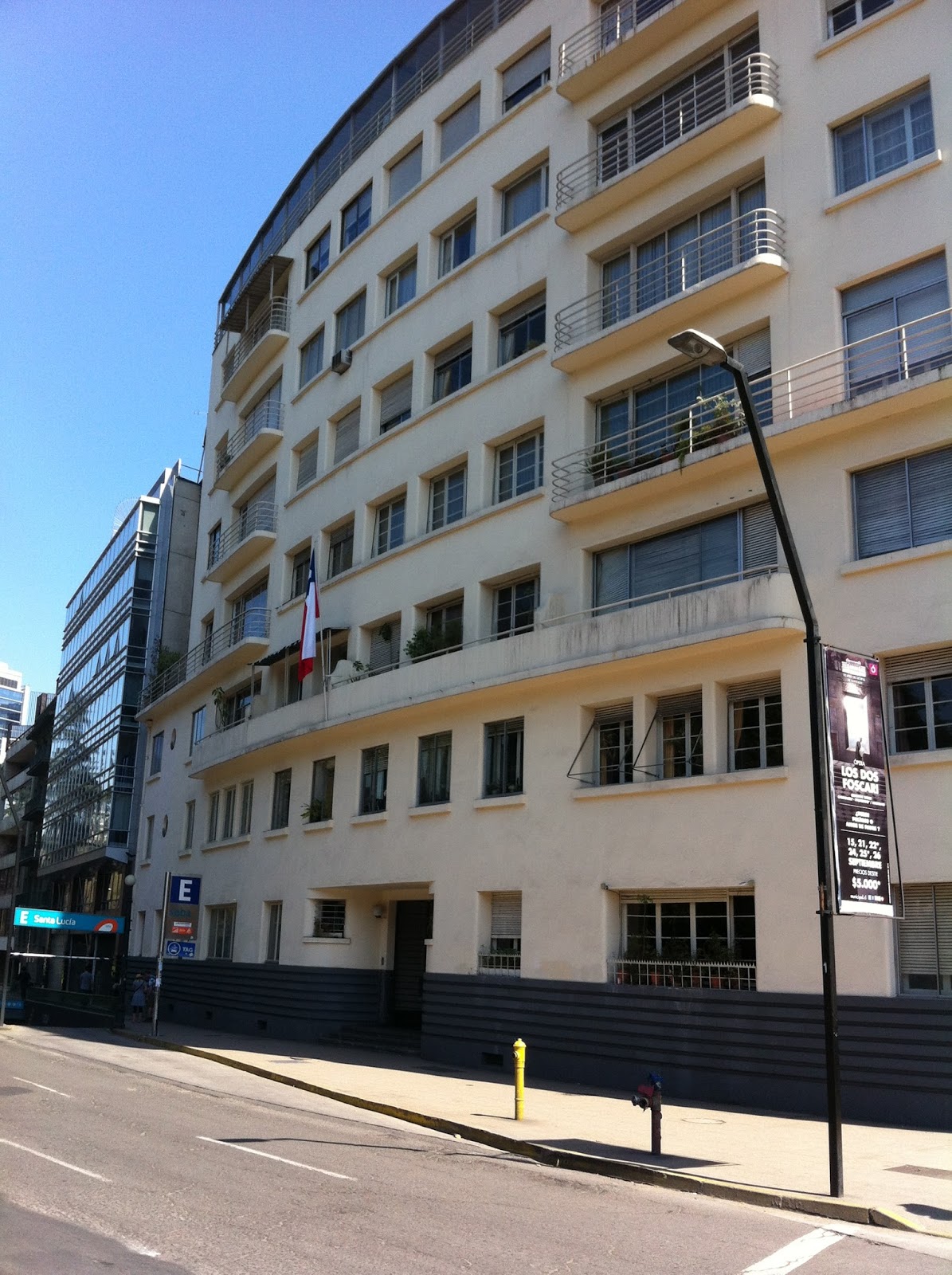
It was my first visit to her apartment, located in a grand Bauhaus-style building built in 1928. The polished brass railing at the entry stairs gleamed. In the elevator, the metal grill door rattled shut. A trip to the past. Dora and her schnauzer Franca greeted us at the door, leading us into a spacious entry hall and living room, filled with antiques, paintings, art-deco lamps, enameled Chinese boxes and books in every room. We’d stepped into a museum. We made our way around the apartment stopping to take in interesting objects and asking their stories. Among her books lying about on table tops, two caught my eye. One very familiar. My memoir. I thumbed through another, biographies, photos and drawings of renowned women writers over the years. I jotted down its title. Dora then invited us to see her daughter’s apartment on an upper floor – white, modern, bare, minimalist.


We stopped for a bite to eat on the outdoor terrace of a nearby café. A tall, bearded, none-too-clean man in loose-fitting clothes entered and offered to draw our portraits. He said, “Such nice-looking ladies. A portrait?”
We smiled. “Thank you, but no.”
He wasn’t easily dissuaded. Looking at me, he asked, “How many boyfriends have you had?”
I flashed my ten fingers several times in the air. He laughed.
A good stretch of the afternoon lay before us. One sister-in-law suggested we explore a new, elegant boutique hotel across the street. In the lobby, we told a uniformed young man that we were just looking. He offered to take us on a tour. In a smooth, silent elevator we rose to the roof garden that included a pool and a bar. The elevator whisked us to another floor where our guide showed us several rooms, all in tones of black and soft grey. Below street level, we visited the spa. Leaving the lobby, our young man handed us brochures with special honeymoon offers. I left my copy on my husband’s night table to see when he returns from his two weeks in Italy.
Our next stop was the Museum of Visual Arts, just around the corner.


A sculptress, who lives in the same apartment building as one sister-in-law, had a major exhibit there, entitled “Tiempo de Piedras”, Time of Stones. The exhibit – a mix of installations, paths, and photographs of stones gathered from river beds and the seacoast – evoked in me the special love I have for stones. They connect me to nature. I couldn’t take my eyes off an exhibit of overlapping, wafer-thin charcoal grey stones arranged in a long horizontal line, simulating the ridges of the Andes. A soft overhead light shone on the ridges, which were suspended from the ceiling, projecting onto the wall the shadow of the bare Andes. Stone is the essential element, the raw material, of these mountains and the detritus carried from their ridges, smoothed and rounded by rushing rivers.

I came away from our downtown visit with two riches: not the memory of music, but of the beauty of stones and the name of the book that called to me from that table in Dora’s apartment, Stefan Bollmann’s “Women Who Write Are Dangerous.” I must have it.