Saturday, June 26, 2021

Covid Roller Coaster


I sit at the kitchen table and study the wall calendar. I do this every-single- day.


Three more days until the winter solstice here in the southern Hemisphere. Thirteen days til the end of the month. Then I’ll turn to a new page and continue counting days. Until quarantine ends. Until Covid-19 gets under control.

I was counting days and weeks and months more than a year ago, thinking “Well maybe just a few more months….” Time concepts have become amorphous, misleading, making predictions useless. It demands of us gargantuan doses of patience and the ability to adjust and reframe what we think of as ‘the future.’ Fortunately, some time concepts are fixed, giving me something to grab on to, to look forward to.

Today I’ll pot the gaily colored primroses I bought to brighten the drab end-of-fall garden. 


Tomorrow. Tomorrow morning (and every morning) I’ll savor a mug of aromatic coffee while reading the newspaper. 


The day after tomorrow I’ve ordered food to be delivered. A weekend of freedom from cooking. Next week. Next week maybe we’ll see our grandchildren.

Spring sparkles brightly in the not too distant future. The emerging sword-like freesia leaves in the garden tell me that I can count on it. Just three more calendar pages.

Summer, just five months away, tantalizes with visions of the temperate forests of southern Chile’s Lake District. How I long for the scent of a forest.

Structure in my days helps move me forward, gets me round the bend …to the next day, week, month. Ongoing projects – writing the historical novel based on my Scottish-American aunt’s life, discovering new facts on my family tree, exercising to facilitate the healing of a fractured vertebra – these all fill my days.

And I follow the Covid numbers on the news. Falling. Rising. We’re in quarantine again. Hope rides a roller coaster. The numbers creep closer to home. A son calls. His whole family has Covid, though relatively mild. The numbers mean something when they include family members and friends.

 Two days ago, the Delta variant arrived in Chile. Back on the roller coaster again? I turn to the next calendar page…. and hope… and feel amazed at how resilient we are.


Tuesday, May 4, 2021

The Story of a Tortoise


The cardboard box stood in the open doorway of the downtown shop. I peered in. A box of live tortoises. I entered the shop that was lined with burlap bags of lentils, dry beans, chick peas, corn and other grains.

            “Are the tortoises for sale?” I asked. My youngest son, Nicky, would soon be celebrating his sixth birthday. I thought he’d like a pet.

They all looked the same, so I reached into the box and pulled one out. The shopkeeper put him in a small box, tied it with string and poked holes in the top. I carried the box carefully, boarded the metro and arrived home with our new pet.

            Nicky loved the tortoise and named him “Speedy Gonzalez” because on warm days his tortoise walked around the garden at an unexpected pace. We tried different foods with Speedy: ripe bananas, apricots, plums, cherries and leaves and grass in the garden. If he didn’t like something he simply plowed over it like an army tank.

Speedy lived year round in our walled backyard until one very rainy day, I found him floundering in a puddle, head submerged. We wondered if we shouldn’t leave him outside in this weather. We bought a small book about tortoises. They needed to hibernate in a dark indoor place once outdoor temperatures reached lower than ten degrees.

The next fall we placed him in a low cardboard box with a layer of soil in the toolshed. In late spring, when he began to move around, we took him outside in the daytime and returned him to his box on cooler nights.

The years passed by. Nicky, now called Nico, graduated from the university and took a job as a guide in Patagonia. I took over turtle care, though Speedy never required much care. We kept an eye on him in hot weather as he’d sneak into our bedroom and squeeze under a radiator. He loved dark corners. Summer nights he’d find a spot to sleep behind a flower pot, or beside a thick bougainvillea trunk or tucked into a hole he’d carved out. His favorite season is apricot season, when he gorges on the fallen fruit.


After Nico moved on to studies and jobs overseas, I became the official tortoise caretaker. One year, I noticed that Speedy was not his usual tortoise self, less active and eating little. After a few phone calls, I located Francisca, a veterinarian who specialized in tortoises. She informed us that Speedy is a chelonoidis chilensis, but that, in spite of his scientific name, he comes from Argentina. She examined, weighed him, checked inside his mouth and sent me to the other end of town to have him x-rayed. A tortoise x-ray! Results: Speedy had pneumonia and was underweight. Since he wouldn’t eat on his own, we had to feed him special tortoise food, vitamins and antibiotics with a syringe and we couldn’t let him hibernate. We set up a home-made tortoise terrarium: a large clear plastic box with a lamp, a heating element, a thermometer and lined with shredded paper. But Speedy still wanted to hibernate.

I picked him up and looked into his eyes. “No, Speedy! You can’t sleep! You must eat.”

Feeding him was a slow, two-person ordeal. First measure the food into a syringe. Then I’d say to the day’s designated helper (the cleaning lady or my husband) “I’ll hold his neck and open his mouth and you drop in the food.” I’d grab at his squiggly neck but he’d whisk back into his shell. After a tug of war (he has the strength of an ox), I’d manage to pry open is jaw. 

I told the vet, “This is a struggle.”

“Try relaxing him, petting him,” she said.

Okay. I can do that.

If it was too much food, it oozed out of his nose. We’d wait several minutes for him to swallow before repeating the procedure. This process took about half an hour. We did this daily for two winters. Eventually, Speedy became more cooperative and he and I even developed a bond of sorts. Then one spring he finally returned to his normal tortoise behavior.

But this past summer, I noted that once more he was not well. Even the apricots didn’t tempt him. Back to the vet. Blood tests. Antibiotics and vitamins. A kidney problem. Hand feeding again.


Nico has moved back to Chile with his wife and now has a daughter. When I tell him how stressful tortoise feeding has become, he decides it’s time for him to take over care of his tortoise. The vet suggests that to facilitate the feeding, she’ll attach a plastic tube to his shell and insert the other end into a small hole in his neck. 

This costly surgery requires anesthesia. Nico takes Speedy to his house that has a good size walled in garden. But feeding with the tube does not go well. One day as Speedy roamed the garden, the tube came out.

 Yet, the treatment was effective.


Speedy has become more active in the summer sun and developed an appetite. He’s eating apricots, mangos, peaches and the all-time favorite, figs. Now it is fall and he recently has chosen to hibernate, staying active way longer than he ever did in all the years at our house.

People ask: how old is Speedy? Speedy has been in the family for over 35 years. How old he was when we bought him is a mystery.  The family’s two dogs have accepted this reptile into their outdoor territory. And Nico’s two-year-old daughter, Mila, is enjoying getting to know Speedy.

I miss saying good morning to Speedy in our yard after so many years but I’m pleased that he is thriving in his new home.


Saturday, April 10, 2021

Why Do I Write?

Why do I write?

 In the beginning, I was anxious to explore what it has meant to be an expat/immigrant, the significant moments, turning points, and losses in my life and how they have shaped me. Writing has given me insight into what I value most in life. I’ve learned over the years that there is more to writing than naval gazing.

    A group of expat women in a local book club recently bestowed upon me a priceless gift-- the knowledge that my words had touched them deeply. They had invited me to attend their Zoom meeting because they were discussing “Marrying Santiago,” my first book, published five years ago.

They sparkled with enthusiasm, each giving examples of aha moments. Yes! Of course! I know what you mean! I’d written about the pain of giving up my California family home. One woman worried where she and her siblings would meet, once her mother passed and the house was sold. Another brought up the great sacrifices we immigrants have experienced. This statement evoked a general and rigorous nodding of heads. Were our husbands and children cognizant of this? One woman shared that her kids commented on how their lives have been shaped by having a gringa mother. “We wouldn’t be speaking English now!”

    I shared that in my family there’s seldom a reference to the sacrifices, the losses, though I know they’re very aware of it. They know how I love going back to my home turf. It’s clear in “Marrying Santiago.” One woman in the group, who happens to be from Marin County where I grew up, shared that even after six years here in Santiago, it still doesn’t feel like home. After my 49 years here, I can say that making a life in Chile has been a never-ending process. I often refer to myself as an “introduced species,” like my California redwood tree, my roots always reaching deeper with the passage of time. My husband, sons, grandchildren are my nutrients. Memories – of past vacations, family birthdays, lunch in the countryside with friends, solemn occasions like graduations and weddings –  all form part of my root system anchoring me here.

     Yet I’ll always feel like an introduced species.

    Our Zoom gathering ended with all the women present thanking me profusely for having written my book! They loved it, “couldn’t put it down.”  Words that transported me into a euphoric writer’s paradise.


Saturday, January 23, 2021

Green Garden War


Peeking out from among browned needles on the redwood twig in my hand is a new green nub! I check other twigs. More green sprouts. New life. Yes! The redwood I brought as a seedling to Chile from Muir Woods in California thirty years ago is not going to die! It is my forest in our small city backyard. How I love inhaling its evocative pungent scent and watching its feathery branches swishing in the wind.

            When I brought the sapling here in a plastic tube, global warming hadn’t hit Santiago yet. It still rained regularly in fall, winter and spring. I never doubted the sequoia would adjust to this Mediterranean climate. Now, after fourteen years of drought, the trees in our neighborhood are dying and the redwood is close to being more brown than green. I’ve begun slow-watering it and observe with hope the progress of the new green growth.

Then the parrots arrive.

The non-native invasive Argentine parrots have taken over the city’s avian air space and food sources. They prefer building their basket-like, bulky condos in conifers. This year they’ve been sampling the flavors of my redwood and seem to find them tasty. When I realize that the small, top branches are bare, I declare a parrot war. I haul out the hose, adjusting the spigot to achieve a long, narrow stream, and aim the water to the highest branches where several green parrots are dining. Depending on the water pressure, I can almost reach the top. Sometimes I manage to hit them and they fly off in a chorus of squawking. I turn off the water and return to whatever I was doing before the parrot arrival. Yet, soon I hear more squawking and I must rush back to the hose again. Sometimes hubby helps, but we realize that this is an impossible task.

He sends out a plea to the family WhatsApp for a BB gun. A nephew arrives with his “rifle” and demonstrates how to use it. We’ve never had a gun of any sort in our house. I never imagined that we, a bird-watching family with a shelf filled with bird books, would be in favor of shooting the feathered creatures. But it was either the redwood or the parrots.

From an upstairs window, my husband takes aim and –pop! At first nothing happens, but then- squawk, squawk and off they fly, disgruntled with that disruption of their meal. Later, when they return, hubby takes aim. Pop! “Got one!” I look out to the garden and there lies a beautiful green parrot on the ground. It tries to fly, but only makes it short distances. My first reaction is to go to it, pick it up and coddle it. It manages to climb into a thick, tangled mass of ivy on the garden wall. Suddenly, we are faced with a dilemma. Our intention was not to injure a bird, just scare them until they learned their lesson.

            “I don’t want it to suffer.” I’m surprised at the intense sadness I feel.

 “Well, we want to get rid of them, don’t we?” says my husband, but I know he is upset as well.

            We search among the tangled ivy vines unsuccessfully. Is his soft green form languishing amidst the leaves or has he managed to climb to the top of the garden wall and fly off to join his clan? I doubt he’s able to fly again.

 We’ve put ourselves in this moral dilemma: the redwood or the parrots. There are hordes of parrots in every neighborhood. Only a few sequoias. Both introduced species. Will climate change reduce the parrot food supply? Or will my redwood, native to cool coastal California climes, succumb to the blistering summer heat?

So far today, no parrots! Have they learned their lesson? We have. Aim to frighten, not to maim.

Sunday, December 20, 2020

A Christmas Carol Treasure

 Embossed on the red leather cover in gold letters and ringed by a delicate holly wreath are the words A Christmas Carol by Charles Dickens. It is a small book with gilt edges,   ‘a book that can be easily held in the hand and carried to the fireside…’

I’d determined to reread the book to enter the Christmas spirit in this pandemic year. I knew where to find it. In the side cabinet of my grandmother’s desk. Years ago it was to be found on a bookshelf in my family home. I hadn’t held the book in my hands in many years.

It smells old. The copyright is 1920. One hundred years. Because this is a purposeful rereading, I start with the introduction by A. Edward Newton, an American author, publisher and book collector. He tells the history of the book’s first publication and its influences for good in a world seemingly dominated by evil forces, a book, according to Dicken’s friend Lord Jeffrey that ‘had done more good than all the pulpits in Christendom.’

It is a story of redemption. Ghostly revelations spark Scrooge’s nostalgia for his younger, innocent self,  a self-awareness of his mean character in the present, and a gloomy vision of his future self. I can relate. The holiday season makes me nostalgic for Christmas in the Northern Hemisphere with family, especially childhood Christmases. In addition, long months of quarantine have induced me to much self-reflection that I believe also comes with the aging process. Not much time left for self-improvement!

I learn that the small book in my hand is an exact copy of the first edition, following Dicken’s dictates, including four color plates, the title page printed in red and blue, the end papers inside the covers of a Paris green color and gilt edges. I am holding a small treasure.


Our Christmas in this pandemic year will be a simple one in keeping with these times, focusing, as in A Christmas Carol, on extending cheer and love to our family, friends and neighbors.

 May these be our gifts throughout the year.


Saturday, December 12, 2020

Coronavirus Christmas 2020


Christmas in the southern hemisphere where I’ve lived for the past 48 years is quite unlike my previous Christmases in California, distinguished by the fragrance of fir emanating from our live Christmas tree, the cold nippy air outside, Christmas card writing, gift wrapping, mall shopping, carols on the radio, the fireplace ablaze, the thoughtful placing of the figures in the Nativity scene. As the only child, I was the focal point of the day among parents, grandparents and great-aunts. My only uncle was an Air Force pilot, so he, my aunt and two boy cousins weren’t always around. Gathered in our living room, we read each gift tag aloud and handed over the package, waiting to see and proclaim over the contents.

    My first Christmas in Chile was a shock: sweltering days, a drooping pine branch with a few red ornaments, a crèche in the fireplace, in-laws, sisters- and brother-in-law and a gaggle of noisy nieces and nephews. Gift distribution was mayhem. Kids opened their presents in one big explosion of flying wrapping paper and ripped-open boxes. Over the years as I became accepted as one of the family, I suggested a bit of order might make it more enjoyable. In more recent years, when we’ve hosted Christmas at our house, my grandchildren helped decorate the tree with my old family ornaments, and we named a teenage Santa Claus who donned a red hat and white beard. Yet Santa always seemed to be in a hurry. My idea of order was difficult to maintain.

    Now we are the grandparents and the great-aunts and uncles. The younger generation has been hosting the December 24th dinners. Families have grown as has the number of children present. The mayhem has returned. I didn’t put up our artificial tree last year for the first time. We’d be going to the grandkids’ house. I’d be the only one in our home to stop and notice the gleaming reflections of the colored lights in the silver, red and gold ornaments.

    This year I don’t know if it’s wise for us “seniors” to expose ourselves to the younger generations, who have not been strictly social distancing. I’m imagining a quieter 2020 Christmas Eve dinner at our house with just our generation. I don’t know if they’ll agree to this cautious gringa’s idea. But, after all, on the 25th we’ll all be spending Christmas Day at our offspring’s homes. I’ll do my shopping online or in small stores. I’ll definitely set up the Nativity scene. Still undecided whether to put up a tree.

     To get into the holiday spirit, I’ll prepare the old family recipe for Scottish shortbread with my IPad tuned to Christmas music, reread my mother’s old copy of “A Christmas Carol,” and each morning I’ll water my zinnias while reflecting upon the most solemn lesson of this Coronavirus Christmas – the Interconnectedness of All.


Monday, October 26, 2020

“Pay attention. Be astonished. Tell about it.” Mary Oliver.


Yesterday, a warm spring day, I watched four consecutive episodes of “The Big Bang Theory.” I needed to laugh. Eight months of social distancing plus the past month house-bound recovering from hip replacement surgery require special self-permission to use my time in whatever ways lifts my spirits.

    I’ve had time to reflect. Too much time. Negative thoughts and regrets have been in surplus. Yet, as I begin to feel better physically, positive sparks have begun to surface. Words like grace, patience and gratitude.

    Gratitude.

    I make a list. At the top of the list is Carola, our part time maid who now is my patient, angelic caregiver. Always a smile, never complaining. She’s just a couple years younger than I, and yet is able to do the housekeeping that my body resists. My appreciation (and my husband’s, as well) had already grown by leaps and bounds during the four months of quarantine that kept her from coming.

    My family. Sons, daughters-in-law, grandchildren, sisters-in-law. How I miss the grandchildren’s visits and their hugs. I want to touch their skin. Facetime and videos are poor substitutes.

    Friends. Those that go way back to childhood. Friendships that had lapsed over the years, now renewed. We find plenty to talk about: books, health, our gardens, politics.

    My garden. I spend hours sitting there and observing. Robins have built a nest in the bougainvillea and continue, even after a week, to line their nest with lush grass and clumps of soil. A royal robin nest. I watch the flowers taking turns unfolding in these warming days: the snowball bush blooms are fading; the tiny yellow ranunculus glow brightly, reminding me of the buttercups of my childhood; the California blue-eyed grass sparkles in the sunlight. The seedlings: one tomato plant now with perky yellow blooms; the zinnias holding promise of bright summertime colors.


    And the trees. The branches of our ancient, sturdy apricot are lined with tiny green fruit. Perhaps the most heartening news regards my redwood tree that I’d worried about. Upon very close inspection, I discovered tender verdant shoots among the summer-browned needles of the redwood.

    Rewards of paying attention.

Tuesday, August 25, 2020

                                             In Praise of Redwoods

In these challenging quarantine times, the appearance of pink cherry blossoms, spring’s harbingers, in the park where I walk is a spark of light and hope. Spring is officially a month away here in Chile but the warmer days have encouraged the blossoms to show off their cheery, silken beauty.


    That hope helps me bear the tragic news of the wildfires in California, my home state. Most saddening is the news of the devastation of the Big Basin Redwoods State Park. I know the territory well. In the 1950’s for four years I attended Huckleberry Woods, a Girl Scout camp in Big Basin. What a priceless childhood experience to be immersed for two weeks among ancient redwoods.

    It’s no wonder I became an avid tree-hugger.

    And we were truly immersed. Divided into groups according to age, we were assigned to separate areas in the woods. We slept in sleeping bags on the ground, softened by accumulations of fragrant redwood needles. The towering trees were our only roof. We lashed sticks together with twine using our knowledge of knots to construct shelves and hangers for our belongings. There were latrines and cubicles for bucket showers with water we heated in an oil drum over a fire. We took turns with fire duty.


    It was inevitable that we’d develop crushes on our counsellors, young women with names like Chipmunk, Otter, Bluejay and Termite. Cottontail was our rather stern nurse. The young male cooks in our outdoor kitchen and dining area were also the objects of our girlish infatuation.


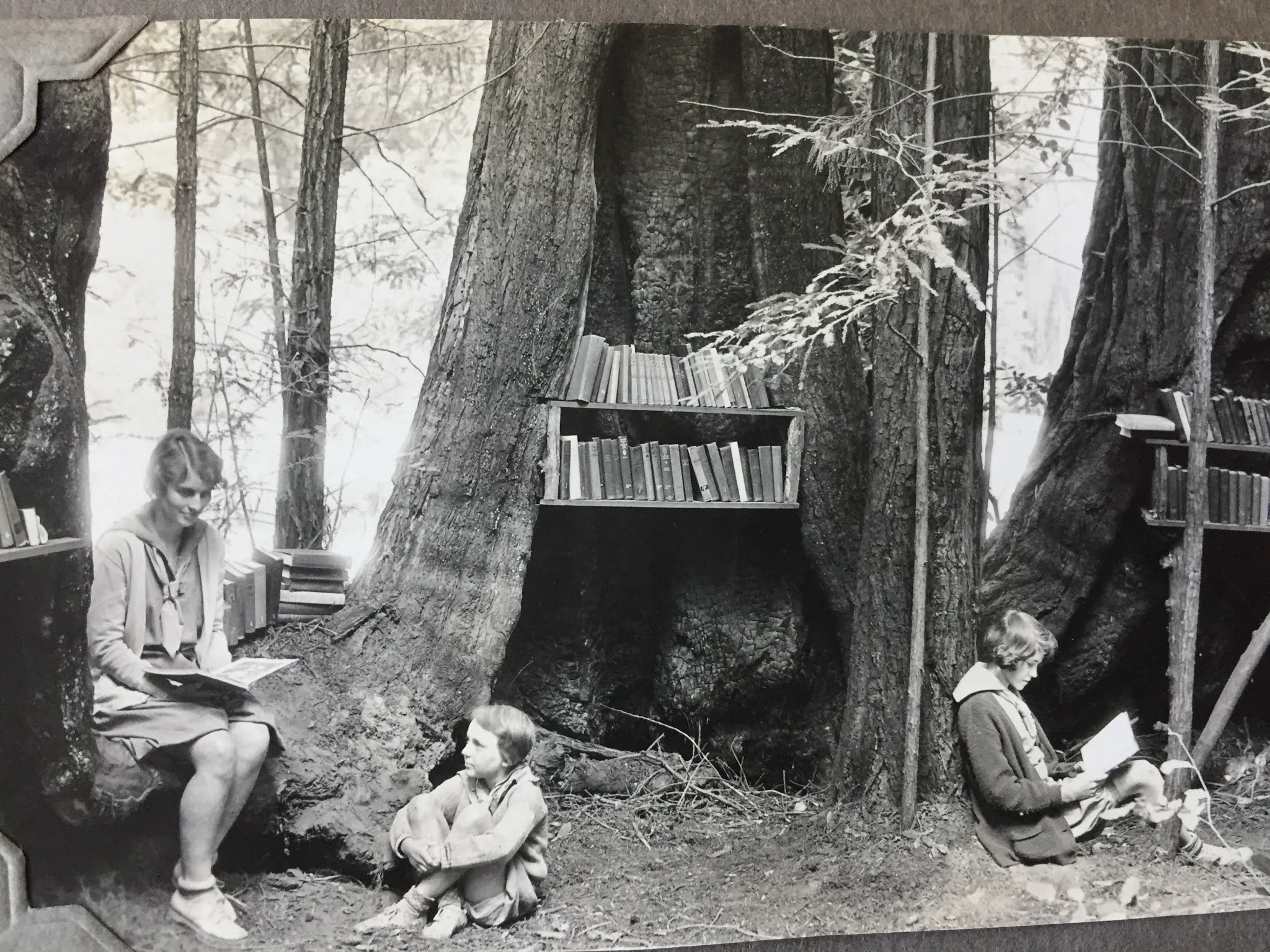
Each chilly morning we’d rise to the call of the bugle and dress in our camp uniform, shorts and a pull-on blouse, called ‘Greenies’ (of course, they were green) and a maroon tie knotted twisted into a unique square -ish knot. We started our day with a flag raising and the National Anthem. After a hot oatmeal breakfast, we’d wash our mess kits in a bucket and head off for a morning activity: straightening our ‘nests’, practicing archery, elaborating crafts, checking a book out of the library installed within a gigantic burned out redwood trunk or washing our clothes in large buckets with washboards and Fels Naptha soap bars. After lunch, we had a rest period for reading or writing letters and later could choose a hike or head for a swim in the chilly water of the natural, fern-lined swimming hole fed by a small waterfall. At the Rock Slide, an open hillside covered with a smooth flat layer of rock, we would stargaze and sing at twilight.


Not a day went by without song, while hiking or sitting on logs around the campfire: Negro spirituals, cowboy ditties and American folk songs. “We are climbing Jacob’s ladder…,” or “My home’s in Montana….”  Snuggled into our sleeping bags in the dark, we’d listen for the mournful notes of taps resounding amongst the redwoods and then waited for the serenade. Hidden from view, our counsellors would sing us into slumber. “Desert silvery blue beneath the pale moonlight..,” or “Down yonder green valley where streamlets meander….”

Aside from my memories of Huckleberry Woods, Big Basin holds particular significance for me because my mother attended camp there in the 1930’s, then known as Camp Chaparral. In the photos camp life seems quite like what I experienced, building character and outdoor skills within the magnificence and wisdom of centuries-old redwoods.


Redwoods are known to be fire-resistant. In any redwood forest it is common to come across blackened, flame-licked trunks of a living tree. I pray that Big Basin’s sequoias sempervirens will abide for another millennia to offer their beauty and wisdom to generations to come.

Monday, July 20, 2020

Muffin Days


ENVY. Yes. Full blown envy is what I feel when I contemplate the photos of natural landscapes on Facebook: a woodland trail by friend Allyson’s Toronto home, Scarlett’s miniature roses with a background of rolling California hills, sunset at the ocean by Chile’s coast. In response to a FB post by the Nature Conservancy, dozens send in snapshots of their local woods and lakes.  Such good fortune to live in those places, I think, while I’ve been in quarantine for four months in this city, currently of 8 million. I grew up in a place of great natural beauty and now in these pandemic times I long for the country.

flowering tarweed at Phoenix Lake, Marin Co. California

        Connecting to Nature is my salve, my comfort and my delight especially in these hard times, but most of Nature is out of reach for city dwellers for now. What to do? I pay attention: to the deep blue sky dappled with glowing puffs of white clouds, to the carpet of lemon-yellow leaves at the park, to the exhilarating sight of fresh snow on the Andes.
    Today, ignoring the strict lockdown, I take a walk to a small nearby park. There I feast my eyes on lemony yellow leaves carpeting the ground. In the distance I can just make out the fresh snow on the Andes. Yes. We’ve had several good long rains after many years of drought. On my walk I pull my mask down below my nose to inhale the tingling sharp scent of wet leaves. 
my local plaza

        My walks to the park have become a daily routine. I discovered that walking improves my physical stamina, eases arthritic pain and corrects bad habits formed while being homebound.
        From the start of the quarantine, I found that following my usual routine has been beneficial for my mental health. Yet I still have days of feeling down. Early each morning, I have an inner conversation with myself, a sort of pep talk. What do I have to look forward to today? Maybe a son will call by FaceTime so we can visit with grandchildren. (Family hugs are what I miss most.) I look forward to the rain forecast for tonight. I don’t know why but I get satisfaction from sweeping and mopping the kitchen floor. Unfortunately for my waistline, meals have become bright spots in my days. Both my husband and I have been resorting to comfort food, especially chocolate. But then I had a stern talk with myself to be more disciplined regarding food. Now, if I need comforting I turn to an absorbing book. Comfort reading rather than comfort eating.
     This is an ideal time to develop greater self-control and patience. Each week that the government extends the total quarantine for another week, I’m able to adjust. Another week. Another month. I know it will end eventually, yet as a ‘senior’, I hold a very different perspective of the terms ‘eventually’ and ‘future’ than do the younger generations. It helps me to imagine the immense joy I’ll feel when I can have family over for Sunday lunch or make an outing into the countryside or make that long-awaited trip to Scotland.
        While I make herb-cheese muffins and order online groceries to be delivered, neighbors at the other end of town are organizing soup kitchens. They’re plugging up the leaks in their fragile homes, built of cardboard, sheets of tin and plastic, while I delight in the sight and sound of rain. Families that hunker down in their small crowded spaces, where it’s impossible to practice social distancing, would feel envy and maybe resentment if they were to see my spacious home where now only two of us live and even enjoy the green of our small garden.
        Life in these pandemic times puts society under an enormous magnifying glass, highlighting glaring inequalities: inadequate housing, irregular incomes, students with no computers to do online classes and no Wi-Fi connection. Inequalities have always existed, but now on the television screen they are in our faces, headlined in giant red letters, impossible to ignore or forget; the woman attempting to sweep the water and mud from her house; wet mattresses upended (where will the children sleep tonight?); belongings piled high into a dry corner; buckets and pots filling with rain leaks.
    The Covid-19 restrictions reveal our true colors. Are we willing to forego today’s satisfactions for the long term common good? Televised scenes of massive pool parties and crowded bars reveal a society of young people unwilling to sacrifice for the well-being of their country.
        This quarantine also has made known the positive: public and private campaigns to help the needy; an abundance of time to reflect, to read, to bake muffins, to write, to share humor on social media, to call a sister-in-law who lives alone or to feed the backyard birds.
        Today I’ll go online to contribute once more to an organization that distributes food to the needy, although I know it will never be enough.


Thursday, July 16, 2020

Happy Anniversary?


My husband’s first words to me this morning. I panicked. Did I forget our anniversary? Wait a minute. What month is this? July. We were married in December. What? I said. July 14th, he answered. Oh. It clicked. Forty-eight years ago I arrived in Chile to pursue our relationship – cut short when his U.S. visa expired the previous October. Our courtship needed more time. Forty-eight years later….I’m still in this beautiful country and mother of two sons and grandmother of five.

    Enough time to have witnessed a socialist government, a military coup and dictatorship, the return to democracy, and recently, severe social unrest and… yes, Covid-19 quarantine.

    I still have moments of homesickness, ‘home’ meaning San Anselmo, the town where I grew up. Though I no longer have any family there, I miss the dark green curves of Mt. Tamalpais, the peace and fragrance of Phoenix Lake cupped in a fold of the mountain, the scent of redwood trees, the grassy dome of Mt. Baldy, those geographic landmarks of my early years to which I return yearly, except now in 2020 due to the pandemic.

    For years I struggled with the question: where is ‘home’ for me? I dealt with my struggles by writing two books: Marrying Santiago and Notes from the Bottom of the World.


    Now, after forty-eight years of memories and four months of quarantine, I know that ‘home’ is Santiago, Chile, where my family is – husband, sons, grandkids, nieces, nephews, sisters- and brother-in law. Because of them, this place is ‘home’ for me. Instead of Mt. Tamalpais, I have a view of the magnificent snow-covered Andes.

Saturday, June 27, 2020

Ode to the Bay


Sittin' in the mornin' sun
I'll be sittin' when the evenin' comes
Watchin' the ships roll in
Then I watch 'em roll away again

I'm sittin' on the dock of the bay
Watchin' the tide roll away
I'm sittin' on the dock of the bay
Wastin' time

Otis Redding wrote this favorite song of mine by San Francisco Bay, the Bay of my growing years and beyond, the Bay to which I migrate in early fall, the Bay of my memories.

    First, were the sounds. I'd lie in bed at night hearing the haunting calls of the fog horns warning ships passing through the Golden Gate.


    When I was five, we moved north of the Bridge, where we undertook many bay outings: China Camp where we'd buy tiny pink bay shrimp from Chinese fishermen. Their old wooden wharves and shacks continue there, preserved as an historic site; Tomales Bay where we'd head in rubber boots with buckets and shovels to dig for clams. I remember my surprise seeing my grandmother eating them raw from the shell. My childhood curiosity was piqued by the purple sea anemones clinging to rocks in the shallow water. If I touched them with a stick, they'd squirt water. Also on Tomales Bay was Shell Beach, where we'd head on hot summer days, carrying folded chairs, beach towels, and a picnic down the steep woodsy trail. I had mixed feelings about Shell Beach. The road to get there was windy and I was prone to carsickness. Once there, I'd have to deal with avoiding the jellyfish lurking in those waters.

    My last excursion to Tomales Bay was just a few years ago where I embarked on my first kayaking trip with friends.


    I'll skip the details as I wrote about that outing in my book "Notes from the Bottom of the World." As we neared the shore, I could see Nick's Cove in the distance and the thought of its renowned hot clam chowder urged me on for the final challenging leg of the expedition.

    When you live by a bay, you acquire tastes for shellfish, not only clams, but shrimp and crab. Those early culinary experiences foreshadowed a life in Chile, whose coastal waters provide an abundance of seafood, my all-time favorite being machas (razor clams) a la parmesana.

    I'll bring my bay ode to a close with another song:

Friday, June 12, 2020

Rain and a Fire


RAIN! GLORIOUS, SPLENDOROUS, MARVELOUS RAIN! What a blessing for this parched city. My garden gives thanks; my redwood tells me it’s a happy camper. According to the weatherman, this is most bountiful rain in two years. From a second floor window, I see that the mountains have a fresh cloak of snow. Now, in the afternoon, the sun gleams, drops of water on leaves glisten and the sky is the bluest of blues. So much to be grateful for.
redwood in the rain

     I ran out in the rain to pick up the newspaper this morning and placed it in the oven to disinfect it. Then, with mug of coffee in hand, I joined hubby on the second floor to view on his computer the funeral in England of Betty, his father’s Scottish/Chilean cousin, who passed away at 89-years of age of coronavirus. On her visits here, she entertained us with her wicked humor and feisty character. While watching the service, I noticed the smell of burning paper and rushed downstairs to the kitchen, filled with a thin veil of smoke. I’d forgotten to turn down the temp on the oven since I’d baked chicken yesterday. I pulled out a part of the paper in flames and doused it under the faucet. It was the business section. Oh, well. Hubby warned that I could have burned down the house. I doubt it. I have a very efficient sniffer. The whole house smells of burnt paper.


     The day called for hot butternut squash soup. While it was simmering, I whipped up a batch of granola. Things I do during quarantine, which shows no sign of easing up. And I write (here) and read. Time to download another book. Am thinking of something by John Grisham as I’ve never read any of his books. My sisters-in-law knit during their free quarantine hours: sweaters for newborns and squares to make afghans. One sister-in-law just made a poncho for our year-old granddaughter, Mila. I’ve forgotten how to knit and crochet. I sold my sewing machine years ago and hubby knows he must sew on any of his loose buttons. I’m all thumbs with a needle.
     I think of things that give me pleasure during these lockdown days: the sound of rain, the blue sky, our backyard birds, a clean kitchen floor, unexpected emails, a phone call, a Facetime visit with grandchildren, a good book, chocolate. Surprisingly, the days and weeks fly by.

Thursday, May 28, 2020

Feeling Bitchy


This quarantine feels eternal. I succumbed for two days to feeling crotchety and bitchy, angry at the world: my wooly socks that resisted my efforts to yank them onto my feet; the pull up tab on a tin can of tomatoes that refused pulling up. (Hubby’s comment: what will you do when I’m not around); the soup that boiled over in its pan (because I forgot to turn off the flame); my inability to stop snacking; the misguided who don’t respect the quarantine. I won’t go on.
Then, suddenly, I had a great day, reminding me that nothing is forever. What made it great? The shining sun, inviting the fall leaves to show off their golden and ruby colors; a morning email informing me that online magazine Literary Traveler accepted an article I’d submitted (yes!); Radio Beethoven playing Rossini’s overture to the opera Masmetto II, and ALL music, for that matter, now that our only classical music station is back on the air after a lapse of several months, just in time for quarantine. I think ahead to the joy of attending a live concert in the future.
It’s important these days to have things to look forward to. I’ll be relieved to visit the dentist. I’ve had a loose molar since the beginning of quarantine and I’m tired of months of chewing my food on one side of my mouth.
Rain is announced for the next couple of days. I pray that the weather app knows its stuff. How I long to hear the swish of a heavy rain. All the growing things in my garden and the surrounding dull brown hills would give thanks as well.
 How satisfying and comforting the books I’ve read in this time of solitude, (more satisfying than snack food), the last two written by Sue Monk Kidd. Now I’m reading The Last Wilderness by Neil Ansell, who describes his solitary walks through the Scottish Highlands. Anything to put me in a Scottish frame of mind as I sit in front of my computer waiting for inspiration on my novel. I wanted to play some Scottish music but the CD player wouldn’t cooperate. I’ll have to try YouTube
            I’ll enjoy preparing for our book club meeting in 10 days, via zoom. I will be the moderator as I suggested this month’s book The Invention of Nature. Alexander Von Humboldt’s New World by Andrea Wulf. What an extraordinary, brilliant man Von Humboldt and so unknown. This fascinating book is a must for all nature lovers. I had my son bring me a copy from the States because I wanted to be able to underline and place the volume on my bookshelf among the keepers.


            In this time of contemplation many turn to nature for spiritual sustenance. How fortunate are those who live in the countryside or at the coast, in less developed places. Our city garden is small but I can look out my back window and rest my eyes on the feathery branches of the California redwood tree I brought to Chile as a seedling thirty years ago. It is my forest.

Thursday, May 21, 2020

Scotsmen on My Mind


Two-week Coronavirus lockdown again. The entire city of Santiago. If I’m not allowed out, I determine to make good use of my free time (when not cooking, sweeping, ordering groceries on line). So this is the perfect time to pour myself into my writing. Right? My historical novel based on the life of a Scottish great-aunt. It’s actually more research than writing. The research takes me there. As I study the family tree on my computer screen, long dead family members come alive. The past few days I’ve been reading about early 19th century Gibraltar, where my grandmother spent time as a governess for a naval captain’s children. I have a few photographs she took while there which give me inspiration and give flight to my imagination – two small boys in sailor suits, the family with my grandmother,  officers in dress uniform, aa Royal Navy steamship.
What better way to get into a Scottish frame of mind than to immerse myself in the world of the Outlander series? Jamie Fraser is my kind of Scotsman: blue-eyes, red hair, powerful physique and winning accent. Exposed to my Outlander marathon, I just may slip into speaking like a true Scotswoman! After all, it’s in my DNA.
So I deal with quarantine retreating into an imaginary world. Aye, I’ve sighed over Jamie Fraser’s brawny good looks, but it’s difficult to imagine myself with someone that young. By the last episode, I’d changed my loyalties for that tough, gray-bearded rakish Murtagh Fitzgibbons Fraser. Enamored, I check him out on Google. Damn. He’s twenty years younger than I.     
Well, I did marry a Gordon, a Spanish-speaking Chilean, twice removed from Scotland. The only thing Scottish about him is his last name. When I met him, he looked more like Pancho Villa, moustache and all, than Jamie or Murtagh.


Sunday, May 10, 2020

Succulents, Weeds and Other Wild Critters


A few days ago I bought myself a Mother’s Day present on-line. A cardboard box of twelve tiny succulent seedlings, along with a spray bottle. On a trip to the drier north months ago I’d gathered cuttings of a variety of succulents and cacti. Though I managed to get them to root in sand, they all dried up after I transplanted them in especially researched and prepared soil. I blame our extremely hot summer and global warming, though you’d think they would have been happy in that climate. I lost several plants this past summer. My two potted tomato plants were not happy campers either. One, after producing a few tomatoes, shriveled and bit the dust. The other one decided to yield one tomato and two promising-looking blooms.

    In the time of quarantine on-line shopping has blossomed. I bought the succulent seedling kit for my two daughters-in-law as well. 

        Yesterday our youngest granddaughter, Mila, celebrated her first birthday. We bought her a set of musical instruments and an animal puzzle (with animal sounds when she places the right piece), all made out of wood.  Mila came with her mom and dad and opened her presents in our front yard, all of us wearing masks, except Mila. No hugs allowed.

        This morning the doorbell rang, which is unusual these days. A big wooden box was delivered. At first sight I thought it was a box of fruit of the season. Apples? Pears? But no. Lined with a large sheet of brown paper, the box held our breakfast: a bag of assorted fresh breads, jars of honey, cream cheese and Nutella, yoghurts, two tea bags, a jar of juice and a little nosegay. Breakfast in a box. What a delight to receive such an unexpected gift! With malls closed, creativity blooms.

        In Coronavirus times, with many options denied, I’m challenged to come up with alternatives for using my time. Cooking is not my favorite pastime, but I feel pleased with myself when I come up with original ideas for using left-overs. I’m a gardener of sorts, but our garden is looking sad now in fall and I can’t go out to buy some bright flowers. I’ll check if I can buy plants online. I’ve been entertaining myself feeding the three birds that consider our tiny garden theirs: a robin and two rufous-collared sparrows. I’m trying to train the robin to come when I whistle. He’s been coming closer to me, but is still very wary. And to think that in San Francisco California, coyotes are romping around as if they owned the place.

        How I miss contact with the natural world. I read about a new hobby in England that combines botany with city streets and sidewalks called botanical chalking. I love the idea! If you identify a weed growing in the cracks, write its name next to it with chalk. The first challenge is to learn to identify the weeds (got plenty in our patch of grass in the back yard)! But this must be in a public space, the idea being to promote an appreciation for those lowly beings we call weeds.


    An interesting, worthwhile project to fill those pandemic hours.